
Impressionism
---
19th Century Experimentation
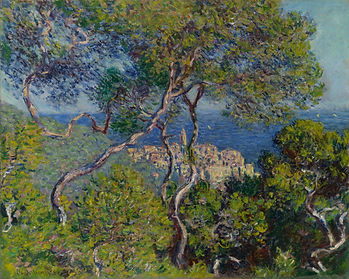
Claude Monet, Bordighera, 1884, oil on canvas, the Art Institute of Chicago.

Paul Cézanne, Auvers, Panoramic View, 1873-75, oil on canvas, the Art Institute of Chicago.
Founding & Associated Members
The Impressionists became a retrospective label to identify a group of artists, although they were not unified in their own right, they tested the boundaries of traditional art practices in in the second-half of the nineteenth century.
Berthe Morisot
1841-1895
---
Born: Bourges, France
Died: Paris, France
Camille Pissarro
1830 - 1903
---
Born: St. Thomas, Danish West Indies
Died: Paris, France
Pierre-Auguste Renoir
1841–1919
---
Born: Limoges, France
Died: Cagnes-sur-Mer, France
Édouard Manet
1832 - 1883
---
Born: Paris, France
Died: Paris, France
Edgar Degas
1834 - 1917
---
Born: Paris, France
Died: Paris, France
Mary Cassatt
1844–1926
---
Born: Allegheny City, PA, USA
Died: Near Paris, France
Claude Monet
1840 - 1926
---
Born: Paris, France
Died: Giverny, France
Paul Cézanne
1839 - 1906
Born: Aix-en-Provence, France
Died: Aix-en-Provence, France
alfred sisley
1839 - 1899
---
Born: Paris, France
Died: Moret-sur-Loing, France
Stylistic Inspiration & Movement Overview
The Impressionist movement is widely attributed to the origin of the Anonymous Society of Painters, Sculptors, Printmakers, which dates back to 1874 (1). The Impressionist movement is known for its color scheme, and the light and airiness focused on the qualities of painting. The inspiration of the movement comes from the interest in light and the incorporation of hues that do not align with the tradition, rather than sticking to the status quo of the Salon and the known schooling of the École des Beaux-Arts. The main drawback of the impressionists was the inferred refutations that the work was superficial, shallow, and unfinished, and to an extend very trivial for not embracing the acceptance of 19th-century European art (2). The movement got its name from Louis Leroy in 1874, from the criticism (3).
Similar to movements that did not adhere to the standards of neoclassical and realistic works, impressionism was discounted for the feminine qualities that the work is associated with, like Rococo. The airiness and color palette were correlated with this interest in the aspects of women, which were considered as less than within the artistic community in the 19th century.
Common Subjects
The Impressionists are distanced from their artistic counterparts by both their stylized way of painting and the subjects depicted in their works. In the past, the accepted scenes were mostly confined to topics and themes within biblical, mythological, and historical genres (4). However, landscapes which the impressionists commonly depicted were acceptable, but on the traditional grounds of realism and traditional techniques of art acceptance in the French Salon. The Impressionists opted for showing landscapes with light as the focus rather than a reality-based representation. The landscapes captured a moment in time and practice of the open-air painting of the impressionists; each season and landscape represented a distinct moment of time, since the light is ever shifting.
Though all the Impressionists had a nontraditional approach that ‘lumped’ them into Impressionism, their themes did overlap in the sense that Degas, Morisot, and Manet frequently depicted women in scenes. Another consistent theme is the technological changes representing modernity in Parisian scenes like trains, railways, and the humble lifestyle of everyday people, unlike the bourgeois, which was not something commonly seen or accepted before (5). However, this is not to say that the impressionists avoided all themes before, as Morisot looked into the lives of bourgeois women.
What makes these themes so distinct is the use of color and hue to imitate light. The impressionists played with the expanding color palette and refuted the use of only dull hues in favor of light and airy pigments.
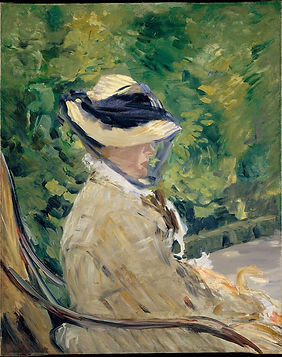
Édouard Manet, Madame Manet (Suzanne Leenhoff, 1829–1906) at Bellevue, 1880, oil on canvas, the Met.

Édouard Manet, Portrait of Berthe Morisot with a Fan, 1874, watercolor over graphite, the Met.
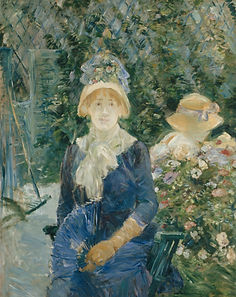
Berthe Morisot, Woman in a Garden, 1882-83, oil on canvas, the Art Institute of Chicago.
Art Historical Impact
Though the Impressionists suffered from financial instability at the time of their practices, their legacy lives on through the collections of their works housed internationally. At the time of the movement, their works were subject to criticism. Nevertheless, art dealers and Americans found the artworks profound, leading the the purchase of many pieces for the United States' permanent collection holdings nearing the early 20th century (6). The general public commonly believes exhibits of French Impressionism through the myriad of hues utilized and the picturesque moments captured by the artists.
Impressionism is now studied by scholars and art historians, despite the distaste that the movement created when turning against the Salon and emphasizing the rejection of the École des Beaux-Arts. Following impressionism, many of the artists related to the movement further developed stylistic divergences, allowing for individual recognition (7). Movements afterwards in the 20th century include post-impressionism and pointillism.
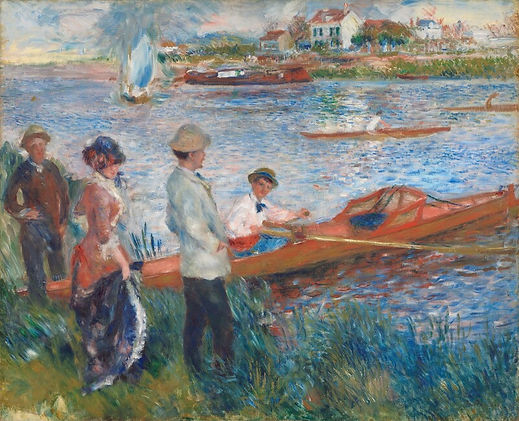
Auguste Renoir, Oarsmen at Chatou, 1879, oil on canvas, the National Gallery of Art.
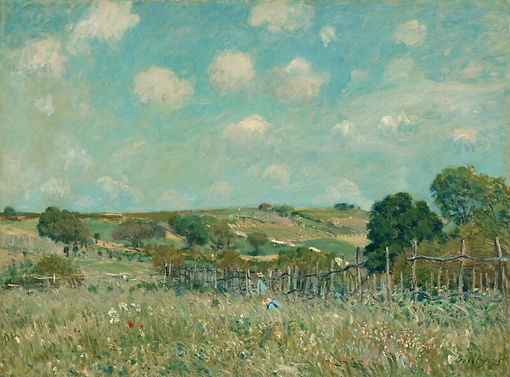
Alfred Sisley, Meadow, 1875, oil on canvas, the National Gallery of Art.
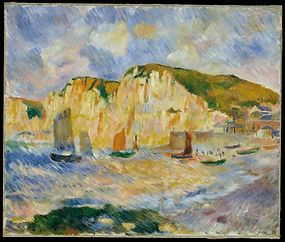
Auguste Renoir, Sea and Cliffs, ca. 1885, oil on canvas, The Met.
Criticism
The Impressionists received much criticism with their formal debut and within the eight exhibitions hosted. Mainly, the contemporaries focused on the inability to determine if their work was formally finished, since they denounced the importance of the thick varnished use at the time alongside focused brushstrokes in their paintings. In comparison to the accepted normalcy and expectation of the Salon, the Impressionists created what is criticized as a shallow depth of field, correlating to their use of hues within the shadows and highlights of the imagery, instead of using black and white to create the accepted norm of depth (8).
In the early 20th century, some writers and observers of the art pieces would take the unblended and slightly abstracted form as a poor excuse for delineated pieces. However, the vibrant shades depicted in their imagery, in hindsight, are what separate them from prior art historical tradition. It is this reaction against realism and the imagination of how the light affects the scenery from open-air paintings that allowed for the Impressionists to rise in scholarly interest in the late 20th and 21st centuries.

Edgar Degas, Yellow Dancers (In the Wings), 1874-76, oil on canvas, the Art Institute of Chicago.

Edgar Degas, Retiring, c. 1883, pastel, with stumping, the Art Institute of Chicago.

Camille Pissarro, A Cowherd at Valhermeil, Auvers-sur-Oise, 1874, oil on canvas, the Met.
Notes
-
“Impressionism: Art and Modernity,” Samu, Margaret, In Heilbrunn Timeline of Art History, New York: The Metropolitan Museum of Art, 2000. https://www.metmuseum.org/essays/impressionism-art-and-modernity.
-
Charles L. Buchanan, “French Impressionism vs. American Landscape,” The Art World 2, no. 1 (1917): 49, https://doi.org/10.2307/25587857.
-
Sura Levine, The Art Bulletin 80, no. 3 (1998): 579, https://doi.org/10.2307/3051309.
-
Lindsay Snider, “A Lasting Impression: French Painters Revolutionize the Art World,” The History Teacher 35, no. 1 (2001): 90, http://www.jstor.org/stable/3054513.
-
"Impressionism: Art and Modernity," Samu.
-
Snider, "A Lasting Impression." 93.
-
Lionello Venturi, “The Aesthetic Idea of Impressionism,” The Journal of Aesthetics and Art Criticism 1, no. 1 (1941): 36, https://doi.org/10.2307/426742.
-
"Impressionism: Art and Modernity," Samu.
Bibliography
Buchanan, Charles L. “French Impressionism vs. American Landscape.” The Art World 2, no. 1 (1917): 48–49. https://doi.org/10.2307/25587857.
Fried, Michael. “Caillebotte’s Impressionism.” Representations, no. 66 (1999): 1–51. https://doi.org/10.2307/2902878.
Galenson, David W., and Bruce A. Weinberg. “Creating Modern Art: The Changing Careers of Painters in France from Impressionism to Cubism.” The American Economic Review 91, no. 4 (2001): 1063–71. http://www.jstor.org/stable/2677826.
Kimball, M. Douglas. “Emile Zola and French Impressionism.” The Bulletin of the Rocky Mountain Modern Language Association 23, no. 2 (1969): 51–57. https://doi.org/10.2307/1346694.
Levine, Sura. The Art Bulletin 80, no. 3 (1998): 578–80. https://doi.org/10.2307/3051309.
National Gallery of Victoria. French Impressionism. https://www.ngv.vic.gov.au/exhibition/french-impressionism/.
Nelson Adkins. “Impressionism 1860-1900s.” Published 2021. https://nelson-atkins.org/fpc/impressionism/.
Samu, Margaret. “Impressionism: Art and Modernity.” In Heilbrunn Timeline of Art History. New York: The Metropolitan Museum of Art, 2000. https://www.metmuseum.org/essays/impressionism-art-and-modernity
Snider, Lindsay. “A Lasting Impression: French Painters Revolutionize the Art World.” The History Teacher 35, no. 1 (2001): 89–101. http://www.jstor.org/stable/3054513.
Stephens, Henry G. “Impressionism: The Nineteenth Century’s Distinctive Contribution to Art.” Brush and Pencil 11, no. 4 (1903): 279–97. https://doi.org/10.2307/25505846.
Tate. “Impressionism.” Last modified July 20, 2022. https://www.tate.org.uk/art/art-terms/i/impressionism.
Venturi, Lionello. “The Aesthetic Idea of Impressionism.” The Journal of Aesthetics and Art Criticism 1, no. 1 (1941): 34–45. https://doi.org/10.2307/426742.