
1822 - 1899
Rosa Bonheur
---
Lifetime Works
Versatile Artistry.
Estimated work total:
* 3570 Studies and Sketches (1897)
* 892 Oil Paintings
* 1728 Watercolors, pastels, drawings
* 13 - 18 Sculptures
Adolescence, Recognition, & Education
The oldest of four children to Raymond Bonheur and Sophie Marquis, Marie-Rosalie Bonheur was born in 1822 in Bordeaux, France. The Bonheurs moved to Paris, France, early in Rosa’s life in 1829, despite facing financial hardships. From what is known, Raymond was a landscape painter who taught Rosa. Sophie, Rosa’s mother was a musician and had once studied under Raymond (1). Rosa’s three siblings also went on to become artists; however, Rosa is understood as the most distinguished from her family's lineage. Her father, Raymond, was a part of the Saint Simonian religion, which emphasized the equality of sexes and a female messiah, which may have contributed to the outlook of her later life; however, he left to pursue the religion (2).
At an early age, Rosa’s mother passed. Rosas's interest in animals became a sanctuary for her artistic skills to form (3). Rosa was eleven, and from what is known, her mother's death profoundly impacted her. Later, when Marie-Rosalie decided to adapt her name and signage to Rosa in her twenties (the mid-1840s), the name was an ode to her mother’s nickname given to her (4). Rosa left school at the age of thirteen, where she formally took up studies of art under her father. Rosa spent her formative years studying outdoors and in the studio, meticulously documenting and drafting her studies, as seen with her later work kept in museum collections (5). Notably, like other artists, the Louvre served as a foundation for studying by comparing and copying the master’s works.
Similar to other women artists at the time, Rosa's father encouraged her to sign her works in his name. She refused (6). This act of Rosa's centered her career in dissecting the traditional dichotomy of the male and female spheres in societal aspects.
Despite women's ban on a formal education in art, Rosa became highly successful, receiving recognition from nobles, awards, travel, and enough financial sustenance to support herself and her partners. Bonheur’s work during her contemporary life was recognized overseas, particularly in the United States, where some of her works are now permanently held.
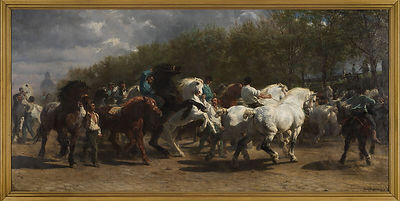
Rosa Bonheur, The Horse Fair, 1852-55, oil on canvas, The Met.
Fame
Bonheur became the first woman to receive the cross of the Legion of Honor, awarded to her in 1865 by France’s Empress Eugénie, wife of the last emperor Napoleon III, but this was only one of many accomplishments attributed to Bonheur (7) . Known for her traditional style of realism and animal paintings, Bonheur started exhibiting at the Paris Salon in 1841. Within a span of less than a decade, Bonheur produced Red Oxen of Cantal, winning her a gold medal at the salon in 1848. Three years prior, Bonheur won third place (8). Bonheur's work was highly esteemed and with the exception of 1850, Bonheur had two or more pieces exhibited at the Salon in any given year (9).
Her exceptional skill gained her the interest of being commissioned by the French government. One of her most famous works, The Horse Fair painted in 1853 and is now held at the Met, while a copy provided by Micas travels due to the fragility of the original painting. Her notoriety led her to direct an art school in Paris from 1850-1860, and become an honorary president of the Société des Femmes Peintres and Sculpteurs (10). However, she had conflicting views about society due to conflicting views on the necessity of having these separate spheres for men and women. Rosa still obliged.
From historical accounts, Bonheur exhibited masculine dress and behavior, especially on the grounds that women were not typically allowed to wear trousers in the public sphere, as seen as a subset of cross-dressing (11). Additionally, with her fame and reputation, nobles did see Bonheur in her traditional working attire, which, from accounts, seemed to infatuate some with this persona.
Trail Blazing
Rosa Bonheur lived an independent lifestyle, unfathomable and not widely-societally acceptable in the 19th century. Bonheur created famous works, getting substantial notoriety from the royalty and public with her career at the Salon starting before twenty. In the 1850s, France required a permit to wear trousers as a woman (12). Bonheur was one of the select few granted this permit, one of a dozen (13). The grounds for her request were granted due to the nature and necessity of her animal studies; as Bonheur traveled to areas within France to study the attitudes and nature of the animals depicted before she purchased her own château near the Fontainebleau forest, allowing her access to sketch and paint when desired, which, described by scholars, was understood as nearly every day (14).
Not only was Bonheur granted permission to wear trousers, but it is well known that she lived with life partners Nathalie Micas and her mother, and until Micas’s death. She then lived with Anna Klumpe, her partner up until her passing (15). Bonheur left Klumpe as her heir and sole recipient of funds following her death, which starkly contrasts with societal expectations of leaving her estate to a husband. Though it would have been scandalous in the 19th century to live and openly state a nonheterosexual identity, Bonheur remained true to herself, with remarks that her closest study of males would be her interest in animals and studying the males.

Rosa Bonheur, Lion, c. 1880, bronze, The Art Institute of Chicago.
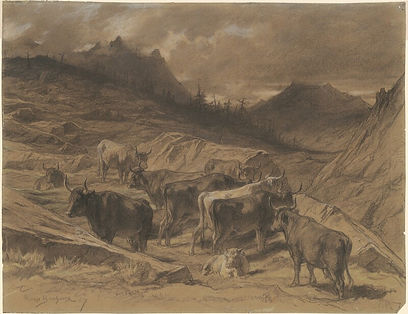
Rosa Bonheur, Cattle in the Auvergne, chalk with stumping and touches of pastel on brown wove paper, 1867, The National Gallery of Art.
Relationships & Later Life
By 1860, nearing 40, Rosa bought the Château at By. There she lived with her partner Nathalie Micas and Micas’s mother. Over a decade prior, Bonheur had lived with the two in 1849 (16). The Micas family supported Nathalie and Rosa together and even went as far, though speculatively, to recognize the two's bond as a marriage. Rosa shared over 40 years with Nathalie, and left everything to her; however, Nathalie passed when Rosa was 67. The pair worked and lived together alongside each other, and in death were buried together (17). Years later, Rosa formed a relationship with Anna Klumpe, with whom she spent the rest of her life.
Additional Works

Rosa Bonheur, Cattle at Rest on a Hillside in the Alps, 1885, oil on canvas, The Art Institute of Chicago.

Rosa Bonheur, The Call of the Stag, 1890s, pastel on brown paper, The Art Institute of Chicago.
Notes
-
Eleanor Tufts, Review of THE CASE FOR ROSA BONHEUR, by Dore Ashton and Denise Browne Hare, Southwest Review 69, no. 4 (1984): 474 http://www.jstor.org/stable/43469702.
-
Laurel Lampela, “Daring to Be Different: A Look at Three Lesbian Artists,” Art Education 54, no. 2 (2001): 46. https://doi.org/10.2307/3193946.
-
Gretchen van Slyke, “Reinventing Matrimony: Rosa Bonheur, Her Mother, and Her Friends,” Women’s Studies Quarterly 19, no. 3/4 (1991): 64, http://www.jstor.org/stable/40003304.
-
Slyke, "Reinventing Matrimony," 67.
-
Rosa Bonheur (1822-1899) From October 18th 2022 to January 15th, 2023, Musée d’Orsay, https://www.musee-orsay.fr/en/whats-on/exhibitions/presentation/rosa-bonheur-1822-1899.
-
Slyke, "Reinventing Matrimony," 67.
-
Tufts, "Review Bonheur," 473.
-
Tufts, "Review Bonheur," 474.
-
Tufts, "Review Bonheur," 474.
-
Gretchen van Slyke, “The Sexual and Textual Politics of Dress: Rosa Bonheur and Her Cross-Dressing Permits,” Nineteenth-Century French Studies 26, no. 3/4 (1998): 332, http://www.jstor.org/stable/23537594.
-
Slyke, “The Sexual Politics of Dress," 330.
-
Slyke, “The Sexual Politics of Dress," 321.
-
Slyke, “The Sexual Politics of Dress," 327.
-
Tufts, "Review Bonheur," 473.
-
Slyke, "Reinventing Matrimony," 68.
-
Slyke, "Reinventing Matrimony," 68.
-
Slyke, "Reinventing Matrimony," 71.
Bibliography
Lampela, Laurel. “Daring to Be Different: A Look at Three Lesbian Artists.” Art Education 54, no. 2 (2001): 45–51. https://doi.org/10.2307/3193946.
Musée d’Orsay. Rosa Bonheur (1822-1899) From October 18th 2022 to January 15th, 2023. https://www.musee-orsay.fr/en/whats-on/exhibitions/presentation/rosa-bonheur-1822-1899.
National Museum of Women in the Arts. “Rosa Bonheur.” Last modified November 19, 2024. https://nmwa.org/art/artists/rosa-bonheur/.
“Rosa Bonheur.” Cosmopolitan Art Journal 2, no. 4 (1858): 193–94. http://www.jstor.org/stable/20487240.
“ROSALINE BONHEUR.” Fine Arts Journal 22, no. 4 (1910): 207–8. http://www.jstor.org/stable/23905900.
Slyke, Gretchen van. “Reinventing Matrimony: Rosa Bonheur, Her Mother, and Her Friends.” Women’s Studies Quarterly 19, no. 3/4 (1991): 59–77. http://www.jstor.org/stable/40003304.
Slyke, Gretchen van. “The Sexual and Textual Politics of Dress: Rosa Bonheur and Her Cross-Dressing Permits.” Nineteenth-Century French Studies 26, no. 3/4 (1998): 321–35. http://www.jstor.org/stable/23537594.
The National Gallery. “Rosa Bonheur.” https://www.nationalgallery.org.uk/artists/rosa-bonheur.
Tufts, Eleanor. Review of THE CASE FOR ROSA BONHEUR, by Dore Ashton and Denise Browne Hare. Southwest Review 69, no. 4 (1984): 473–76. http://www.jstor.org/stable/43469702.