A Detour: Blowing glass
Belger Arts Glass Annex
Kansas CIty, MO
Weekend Intensive Glass Blowing Introduction
Sat/Sun Session
Late February 2026
Full Day Classes
Known as: Glass One
Working in 'THE HOTSHOP'
EXPERIENCE
In late February, I had the opportunity to explore glass blowing at the Belger Arts Glass Annex in Kansas City, MO. As part of my capstone, I sought to challenge myself by at least experimenting with the work done with molten glass in hotshops, and this was an ideal opportunity.
Belger Arts has a gallery to feature exhibitions, purchasable work, and events in addition to having studios and classes for both glass and ceramics. The glass annex is located about a block from the gallery, which ensures the space needed for the artists' creations.
Classes at Belger Arts in glass can consist of hotshop working, cold working, and warm working (fusing), with the class schedule running on a semester and interest-based method. For this class, I chose to do the weekend intensive; however, they also run four-week-long classes, meeting once a week for multiple hours.
In previous experience, I worked with hot glass with flame working, creating beads and marbles, utilizing a torch. However, glass blowing in itself is a different beast with additional considerations due to the risk of the movement of glass coming out of a furnace at 2200 degrees.
Class started at 8:30 am sharp and lasted throughout the afternoon til 5:00 pm on both Saturday and Sunday. Throughout this time, we learned beginner techniques in glass one, which set artists up for glass two or continuing skills through purchased studio time at the Annex.
The glass one class accommodates up to six students who work closely alongside the resident glass blowers at the annex. Additionally, other students work as teams to help build creations, as glass blowing often centralizes teamwork due to multiple requirements.
Some of the techniques we learned consisted of:
- getting gathers from the furnace | This is how to spin and pull the molten glass onto the pipes to get a enogh glass to shape on the tables, which are coated to take the heat.
- creating multiple gathers | Building a larger gather after getting a small pull, reheating and flashing in the glory holes to maintain heat before hand
- how to operate as the 'assistant' | Opening the furnace, wetting the woodblocks for shaping, creating punties for the gaffer's pieces, doing flash fire (to hold heat in the piece) for the gaffer, communication, and bubble blowing
- Shaping glass | After coming out of the furnace using gravity to elongate the piece and blow bubbles through the pipes | Using different tools to manipulate the glass, like tongs, plyers, and woodblocks, at times shears for mistakes
- How to finish a glass piece | Putting on a puntie for transferring and creating a score line to hit to release glass from the pipe lightly | Using thermal resistance gloves and tongs to fire polish and rigid edges, and lastly place in the annealing kiln
- How to use the annealing kiln | The annealing kiln allows blown glass pieces to gently return to room temperature without experiencing thermal shock, which can easily break a piece. Annealing can take over 24 hours dependent on the size and the thickness of the piece created
- How to use colored frit | Glass chips known as 'frit' allow gaffers to add color and patterns to their glass, thereafter it can become difficult to see when the glass is molten and malleable enough to pull out of the glory hole.
I had a wonderful experience during my Glass One class, and I look forward to working on my skills in taking Glass Two and renting studio time in the hopshop. Particularly, I am interested in using the hotshop to make roundels that can be included in leaded stained glass, and using fused glass when blowing to elongate the patterns and designs that I have already made.
Items Created: Paper Weights, Cups, Ornaments, simple forms
Terminology
Learned
Annealing Kilns
Much like fused glass, blown glass needs to be slowly ramped down in segments to the room temperature. These kilns may open from the top or sides, and annealing is highly variable due to the size and thickness of the piece.
Sheilds & Sheilding Methods
Since molten glass is exceedingly hot, the heat radiates beyond the medium itself. When working with molten glass, 'YOU WILL FEEL THE HEAT', to mitigate this, assistances sheild with tools and cool the pipes with water when it get uncomforatble. Additionally, glory holes have movable shields that help block the heat out.
Punties
Punties are used to connect the main piece with a small other pipe, which is solid. The gather is less, and rolled out on a marver to create the small cylinder shape, which allows artists to score off their piece, torch, and head to the annealing kiln.
Other Considerations & Difficulties
- Colors of glass can become exceedingly expensive in comparison to clear glass
- Color can be more difficult to work with, as some frit colors are 'harder' and 'softer' than one another, hence they often do not do well when mixed
- Heating colored pieces can be difficult because gaffers no longer can rely on the orange/red glow and instead have to observe by the movement of the piece how heated or cooled it is
-Though the glass is at an exceedingly high temperature, it cools quickly. When it cools, you will no longer be able to manipulate its form, and if it is attempted or left too long without heat, it may crack
- Risk of popping glass and glass shards is abundant in this environment. For this reason, it is important to wear organic and not synthetic clothes as they are less likely to catch fire. Likewise, open-toe shoes are not permitted and are considered hazardous. It is advised to wear long sleeves and pants in addition to any heat sleeves or additional protective gear. Eye protection is always necessary.
Gaffers v. Assistants
Gaffers
Take the design role of creating the piece. In other terms, the gaffer takes gathers from the furnace that reflect the size of the piece or takes multiple gathers to build a larger product. Gaffers marver the glass and have the creative freedom over the piece. They choose colors and take the glass to be heated in the glory hole and use torches to further manipulate the glass.
Assistants
open the doors for the gaffer to create their best works as they act as the support. Assistants open the furnace doors, make sure that safety guards and efficiency are in place, and communicate with the gaffer through blow pipes when creating bubbles. They ensure tools are prepped, and woodblocks are properly wetted for the further shaping of pieces, and they help with the gaffer getting properly seated in their bench. Assistants make punties, which are lightly adhered to the main piece and eventually allow the gaffer to transfer the piece off the pipe and onto the station with torching edges before loading in the annealing kiln. There may be mutiple gaffers and assistants working at one time, or multiple assistants assigned to one gaffer dependent on the complexity of the piece.
Marver
Similar to marvers for torch work, these marver tables allow for glass to be manipulated without getting stuck, creating cylindrical shaping for initial bubble blowing. Using marvers on the glass does cool it, and makes it less malleable, which in turn usually calls for the piece to be set and rotated in the glory hole to regain heat.
Glory Hole
This revolving chamber keeps heat in and allows both assistants and gaffers to reheat their pieces without having the risk of the glass cooling too much, and therefore cracking. Dependent on needs, one may flash the piece for 30s or focus on a particular part for an extended period with 5s flashes. As the glass warms up, it becomes malleable and may wobble on the pipe, so it is necessary to keep rotating.
Furnace
Where the molten glass is stored and refilled, it often ranges around 2200 degrees Fahrenheit. When glass is at such high temperatures, it appears orange in hue; however, with colors, this can be hard to distinguish when taking a gather how deep you need to go. Furnances have a rolling door where the assistant opens, and the gaffer gathers, creating a team system.
Pieces Created
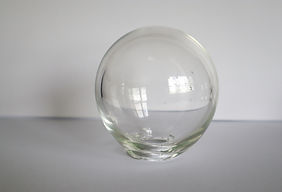
A.
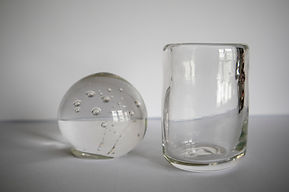
B.


D.
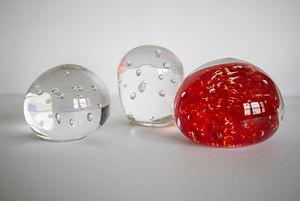
E.
C.
A. Blown Bubble Piece with Opening from Punty
B. Clear Paperweight with Bubbles & Small Glass
C. Glass with Torch Worked Marbles (Previously Created)
D. Glass with Torch Worked Marbles (Previously Created)
F. Three Bubbled Paperweights, One with Color
At Work In the Hotshop

Getting a Gather at the Furnace | Gaffing
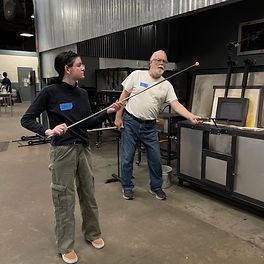
Pulling out a gather for a Punty | Assisting

Shaping glass on the Marver Table | Gaffing
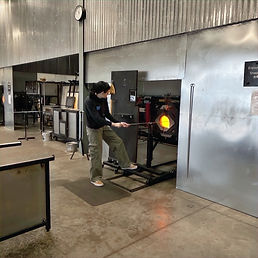
Flash Firing to Hold Heat in the Glory Hole| Gaffing
